
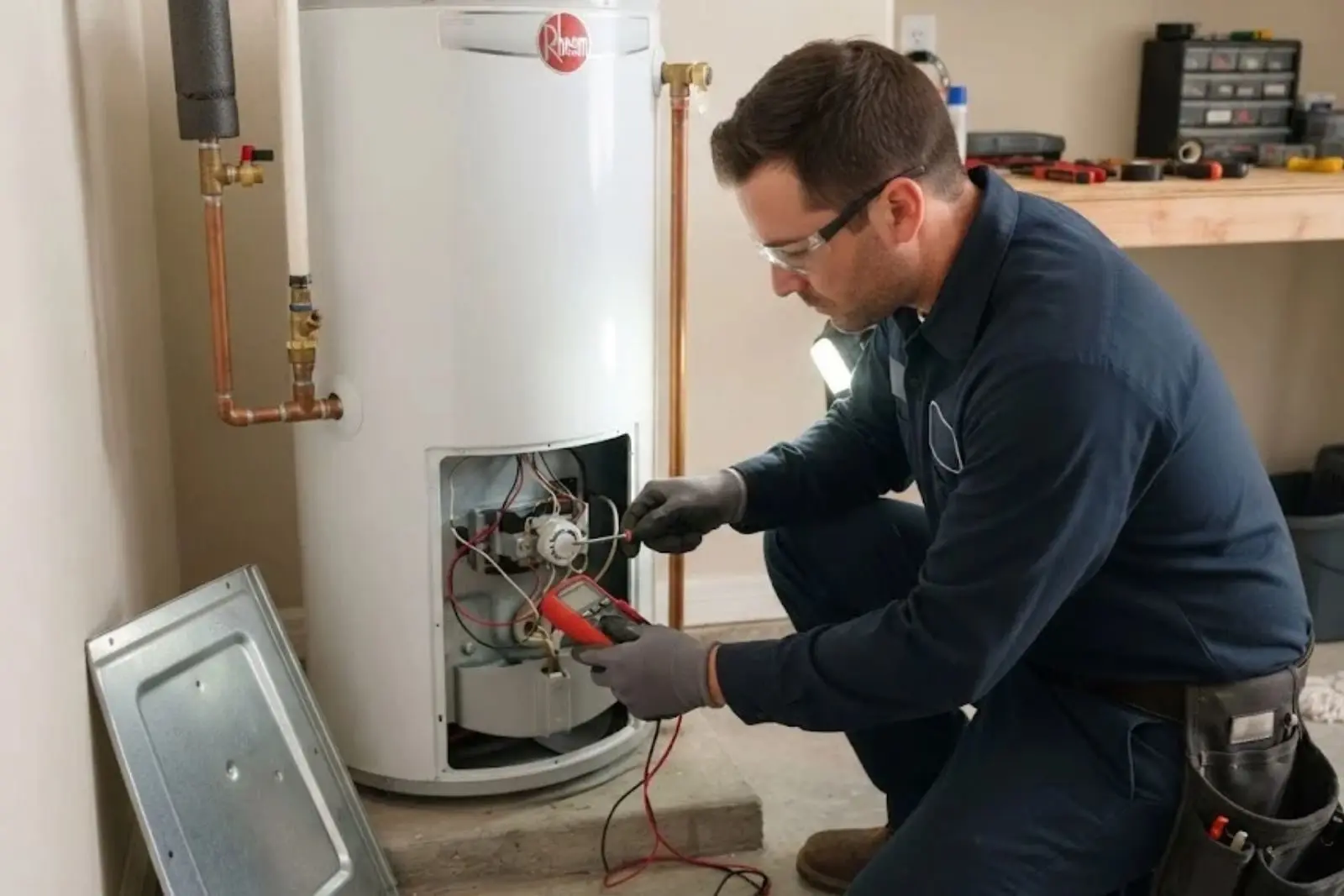
The first things we check on a dead heater
Most no hot water calls come down to a short list. On an electric tank we test the breaker, the high limit reset and both heating elements. On a gas tank we look at the pilot or igniter, the thermocouple, the gas control valve and the vent.
Roughly half of the failures we see are cheap parts. The other half are tanks with a sediment-choked floor or a rusted shell that no part will fix, and we tell you which situation you are in before any parts are ordered.
What the heater is telling you
Each symptom points to a different cause, so describe it as exactly as you can on the phone.
- No hot water at all: tripped breaker, failed thermostat, dead upper element or an out pilot.
- Warm but not hot: a failed lower element, a broken dip tube or a thermostat set too low.
- Water runs hot briefly then cold: failed element, or sediment burying the burner or element.
- Rumbling or popping: scale on the tank bottom, which steals efficiency and can crack the liner.
- Water dripping from the relief valve pipe: pressure or temperature building up, often from a failing expansion control.
- Rotten egg smell from hot water only: a reaction at the anode rod that can be treated.
A leaking water heater is an emergency
Water from the tank body, the base or a corroded fitting needs attention the same day. A slow drip from a pipe fitting can often be repaired. Water from the shell cannot.
- Shut the cold supply valve above the heater and turn the power or gas control off.
- Put a bucket or wet vacuum at the drip and watch whether it slows once the supply is closed.
- Do not touch the unit if water is near an electrical box or the floor around it is soaked.
- Call the 24/7 line and tell the dispatcher where the water is coming from.
Common repairs and how they compare
This is a rough guide to what a repair visit looks like for a standard tank.
| Problem | Typical fix | When replacement wins |
|---|---|---|
| Dead element or thermostat | Replace part, flush tank | Tank over about 12 years or heavy rust |
| Pilot or igniter trouble | Clean, replace thermocouple or igniter | Repeated failures, cracked burner assembly |
| Relief valve dripping | Replace valve, check expansion tank | Valve is fine but pressure keeps spiking, see installation work |
| Leak at fittings | New connectors, dielectric unions | Leak is from the tank shell itself |
Flushing, anode rods and Utah County water
Pleasant Grove's own 2023 report lists dissolved solids up to 396 parts per million, which means mineral scale is part of life here. Draining a few gallons from the bottom valve every year carries sediment out before it hardens.
An anode rod is the sacrificial part that protects the steel tank. If it is down to bare wire, replacing it can add years. We check it during any repair visit because it costs far less than a new tank.
What shapes a repair price
We name the part and the labor before work starts. These are the factors that move the number.
Insurance and warranties
Insurance rarely pays for wear parts. Check whether the heater is still under the maker's warranty, which sometimes covers the part but not our labor.
Want your number now? Call (385) 488-1892 and give the make and the symptoms, and ask for the replacement price too if the unit is near the end of its life.
The relief valve is a safety device, not a leak to ignore
A relief valve that drips or a discharge pipe that runs wet is telling you the tank is too hot or the pressure is too high. The IPC, which Utah applies statewide with amendments, requires this valve for a reason. Never cap the pipe to stop the drip, and call a plumber to find the cause.
Cold water only?
Call the 24/7 line and a plumber can often come the same day when the schedule allows.
Water heater repair questions
Yes. Emergency water heater repair is dispatched 24/7, including weekends and holidays. Tell the dispatcher whether the tank is leaking, because a leak is handled ahead of a no hot water call.
The usual causes are a failed lower element on an electric tank, sediment buildup that takes up tank volume, or a broken dip tube that mixes cold water into the top. A plumber can tell by sound, test readings and a short flush.
It depends on the part, so we quote after diagnosis and before work starts. Parts like thermostats and elements usually cost much less than a replacement, which is why we diagnose first.
If the tank is leaking or well past its expected life, no. If it is under about 10 years old and only a part failed, repair is usually the better value. The plumber compares both prices on the phone or on site.
Leave the area and call 911 and Enbridge Gas Utah at 1-800-767-1689 from a safe place. Do not flip switches or light anything. A plumber can come after the utility clears the home.
Mineral scale from dissolved solids can coat elements and the tank floor, which makes heaters noisy and less efficient. Flushing the tank each year and checking the anode rod helps, and a tap test tells you how aggressive your water is.