
When a clogged drain is an emergency
A single slow sink can wait for a day visit. A toilet that will not flush, water backing up into a tub when you run the washing machine, or sewage smell with gurgling in several drains is an emergency. Those signs point to the main line, and every flush adds to the mess.
- Stop using sinks, tubs, dishwasher and washing machine until a plumber has looked.
- Do not run a chemical drain opener into standing water, because it can burn skin and damage pipe.
- Lift rugs and valuables away from the lowest drain, usually a basement floor drain or shower.
- Call the 24/7 line and say which fixtures bubble or overflow first.
Why kitchen sinks clog differently
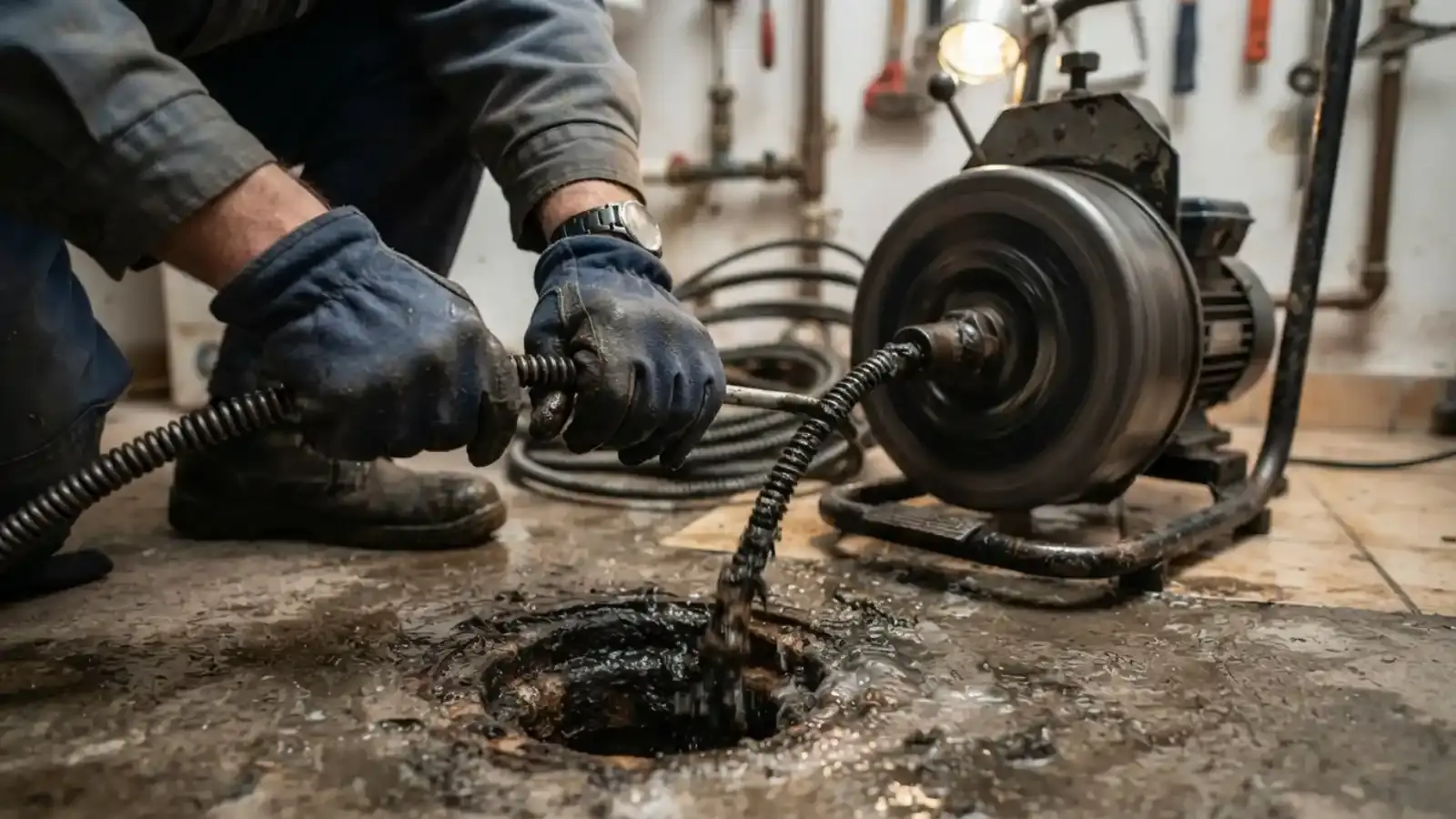
Kitchen drains clog from grease, food starch and soap, which cool into a paste a few feet from the sink. Pouring boiling water helps briefly and then the paste returns. A plumber uses a cable to cut the blockage and often follows with a jetting pass to scour the pipe wall.
If a garbage disposal sits above the clog, we check it before cabling, since a jammed disposal can look like a drain problem. See garbage disposal repair if the unit hums but will not turn.
Signs the problem is bigger than one sink
A single fixture clogs for local reasons. Several fixtures clogging together points to a shared line.
- Water backs up into a tub or shower when the toilet is flushed.
- The lowest drain in the house, often a basement floor drain, bubbles or fills.
- Multiple fixtures drain slowly at the same time.
- Gurgling sounds from drains after the washing machine drains.
- A sewer smell inside, near the floor drain or under a sink.
Which tool for which clog
We pick the tool by clog type and pipe condition. This is how the common methods compare.
| Method | Good for | Limit |
|---|---|---|
| Hand auger | Sink, tub and shower clogs near the fixture | Short reach, stops at tight bends |
| Drum cable machine | Kitchen lines, main line clogs, roots | Cuts a channel, does not scour the pipe wall |
| Camera inspection | Finding the cause of repeat clogs | Diagnosis only, see sewer inspection |
| Hydro jetting | Grease, scale, sand and roots | Not for crushed or collapsed pipe |
A plumber should cable only as far as the pipe condition allows. Brittle cast iron and cracked clay need a gentler approach.
Drain line leaks and repeat clogs
A drain that clears and then clogs again within weeks often has a cause you cannot see. Roots, a bellied section, or a crack that lets soil in will rebuild a blockage over and over. Callers also notice damp spots or a musty smell near a drain line, which can mean the pipe itself is leaking.
We use a camera when a clog repeats or when the symptoms do not match a simple blockage. If it shows a damaged section, sewer line repair is the fix, and cleaning alone will not hold.
Local factors behind drain trouble
Pleasant Grove homes drain into city sewer mains, and wastewater from the city, American Fork, Cedar Hills and Highland is treated by the Timpanogos Special Service District. Backups that hit one house only are usually on the private lateral. A backup on a whole street is worth a call to Pleasant Grove Public Works as well.
Older neighborhoods have more clay and cast iron lines, while newer subdivisions use PVC. Fats from restaurants along State Street and North County Boulevard are a separate commercial issue, covered under commercial plumbing.
What a drain cleaning visit costs
We quote after a short look, before cables come out. The main factors are below.
Insurance note
Homeowner policies often exclude backups unless you carry a water backup endorsement. Check yours, and photograph any damage before you clean up.
Call (385) 488-1892 and describe which drains are slow. For a line that keeps returning, mention you want a camera look at the main line as well.
Why cleanouts matter
Utah applies the International Plumbing Code (IPC) statewide, with state amendments, under Utah Code Title 15A, Chapter 3, Part 3. The model code calls for cleanouts at key points in a drain system, which is why a house with an accessible cleanout is quicker and cheaper to clear than one without. If yours is buried or missing, ask us about adding one during the next visit.
Do not wait on a backup
Call the 24/7 line and stop using water in the meantime.
Drain cleaning questions
Yes. Backups are treated as emergencies and the line is open 24/7. After-hours calls carry an emergency rate, and the dispatcher states it before a plumber is sent.
Avoid them when you can. They rarely clear grease or roots, they can sit in the pipe and harm plumbers, and they damage some pipe materials. A cable or jetting pass is more reliable.
Grease and food residue form a paste that rebuilds after each clearing. Cabling plus a jetting pass removes the coating, and avoiding grease in the sink slows the return.
If more than one fixture backs up, especially the lowest ones, the main line is likely involved. A single slow fixture is usually local.
Yes, with a camera. It shows roots, offsets, scale and cracks so we can fix the cause, not just the blockage.
Yes. Basement floor drains, laundry standpipes and yard drains are common calls. Underground gutter drains are a separate blockage type and our blog covers them.