What the heat exchanger does
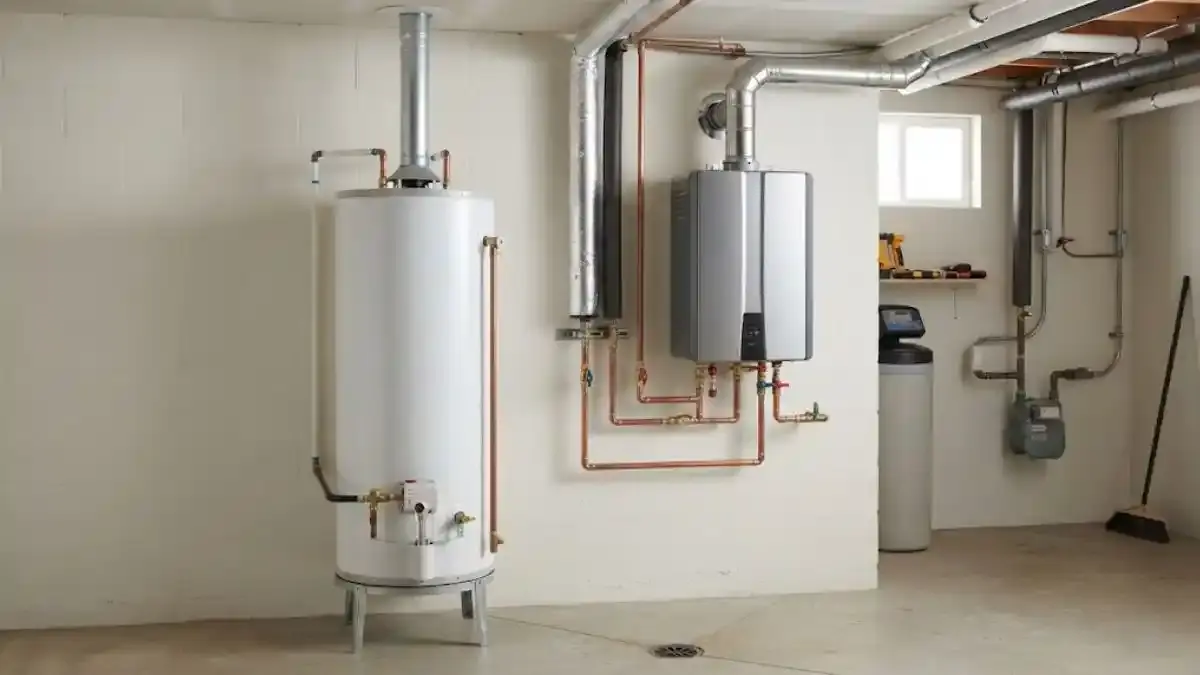
A tankless unit has a burner and a heat exchanger, a set of narrow copper or stainless passages that carry water past the flame. Water enters cold and leaves hot in seconds. Because the passages are narrow, anything that builds up inside restricts flow and heat transfer.
Many units have two exchangers, a primary and a secondary, and a failure in one may leave the other working. A plumber with the model number can tell which part you have.
Signs of a scaled or failing exchanger
These symptoms often appear in stages. Early ones respond to descaling.
- Hot water that runs lukewarm or fluctuates between hot and cold.
- Error codes about overheating, flow or ignition.
- A kettle-like rumbling or popping from the unit.
- Reduced flow at the tap even though supply pressure is fine.
- Water dripping from the bottom of the unit, which can mean a cracked exchanger or a loose fitting.
How hard water kills heat exchangers
Dissolved calcium and magnesium come out of water when it is heated and form scale on the hottest surfaces. In a tankless unit, that surface is the exchanger. A thin layer of scale insulates the metal and forces the burner to run hotter and longer.
Utah County water carries dissolved minerals, and Pleasant Grove homes often see scale on fixtures. A home test tells you how hard your tap water is. See water softener and filtration for how to test before buying a system.
How descaling works
Descaling is a routine job that a plumber or a careful homeowner can do with the right kit.
Isolate the unit
Close the isolation valves so water and gas are cut off from the lines.
Connect a pump
Attach hoses to the service ports and a small pump and bucket.
Circulate cleaner
Run a food-safe descaling solution through the exchanger for the time the maker advises.
Flush and test
Rinse with clean water, reopen valves and check for leaks and normal temperature.
When to repair and when to replace
The choice depends on the damage and the age of the unit.
| Condition | Usual response |
|---|---|
| Light scale, error codes clear after descaling | Descale and set up yearly service |
| Heavy scale, repeated overheating | Descale, then check the exchanger for damage |
| Cracked or leaking exchanger | Replace the exchanger if the unit is young, or the whole unit |
| Unit past fifteen years with multiple faults | Replace, see water heater replacement |
Warranty terms often require proof of yearly descaling, so keep your service records.
Local water note
Pleasant Grove publishes an annual water quality report, and the Utah Geological Survey has published work on groundwater quality in Utah County. We do not quote one hardness figure for every home, since it varies by source and season. A home test kit or a lab test at your tap gives the figure for your address.
Source type: City of Pleasant Grove water quality report and Utah Geological Survey publications
Keeping a tankless unit healthy
Flush the unit once a year, and more often if your water is hard. Clean the inlet filter, check the vent and keep the area around the unit clear. A softener reduces scale but must be maintained too.
If you are weighing a swap, water heater repair explains the basic checks. For neighbors in nearby cities, our pages for Highland and Cedar Hills show where we dispatch.
Reading the signals before you call
Most tankless units show a code on the panel when they sense trouble. Write the code down, along with the make and model, before you call. Many codes point to flow, ignition or temperature problems, and a plumber can often tell from the code whether scale is the cause.
Do not reset the unit again and again. Repeated restarts can hide a developing fault and stress the burner. If the code returns after one reset, leave it off and call.
What to keep for warranty and resale
A tidy record helps with warranty claims and shows a buyer the unit was cared for.
- The date of each descaling and who did it.
- The model and serial number from the label.
- Photos of the unit and the vent before and after service.
- Receipts for filters, cleaners and parts.
- Any error codes that appeared and what fixed them.
Why early service costs less than late repair
A scaled heat exchanger works harder every month. The burner runs longer to reach the same temperature, gas use goes up and the metal sees more heat stress. A routine descale costs little, and a new exchanger or a replacement unit costs far more.
Ask for service when you first notice slow heating or an error code, not after a failure. If the unit is older and the maker no longer stocks parts, compare repair quotes with the price of a new unit, and ask about the remaining warranty.
What to do this month
Check your manual for the descaling schedule, write down the model and serial number and book a service visit if it has been over a year. Clean the inlet filter while you are at it, and keep the area around the unit clear.
If you see error codes or lukewarm water, do not wait. Early service is cheap, and a neglected exchanger is not.
Heat exchanger questions
Once a year is a common rule, and more often in hard water. Check your manual, since warranty terms may require it.
Many owners do, with a small pump, hoses and a descaling solution. Follow the manual, and call a plumber if you are not comfortable working with gas appliances.
It often means restricted flow from scale, a clogged filter or a closed valve. Check the filter and valves, then descale if needed.
A water leak can damage the unit and the surrounding area. If you smell gas or exhaust, leave the house and call 911.
It reduces scale buildup but does not eliminate it. Yearly descaling is still wise.
Utah County water is mineral-rich in many places. We do not claim a figure, so test your tap.