
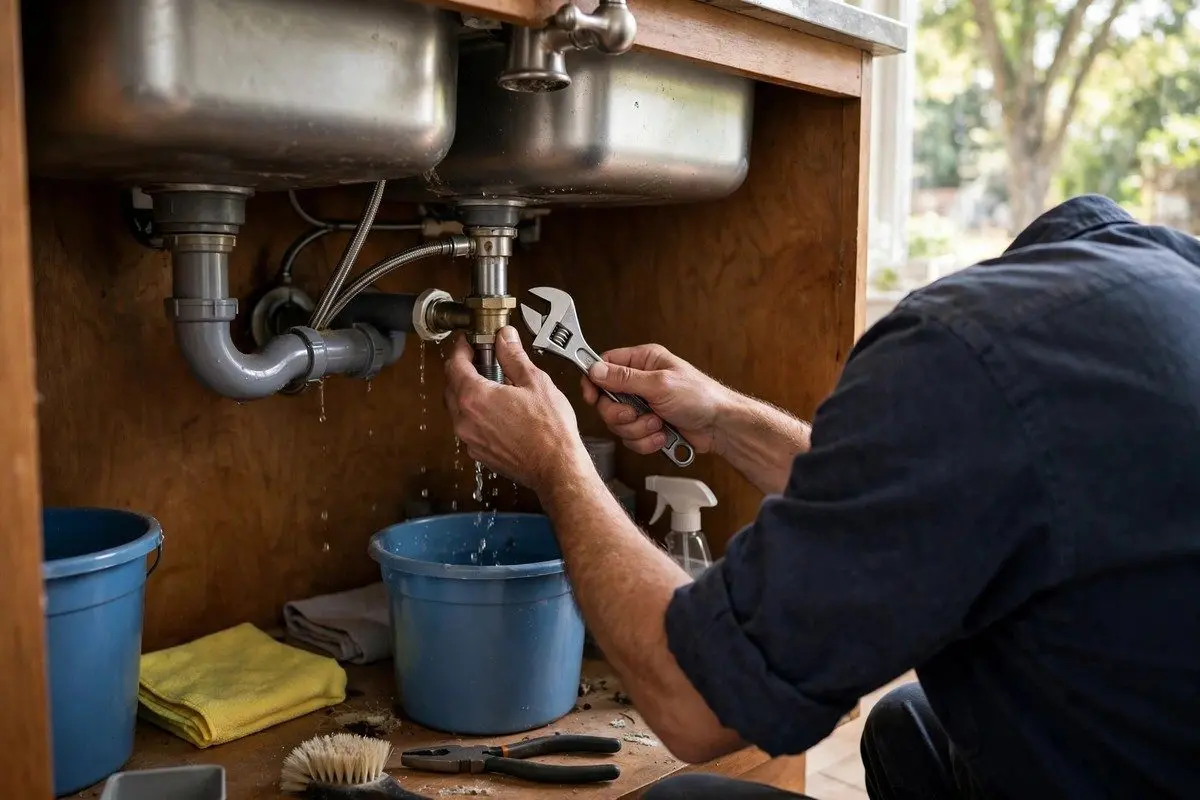
What makes up a sink plumbing setup
Every sink has the same basic parts. Two shutoff valves, called angle stops, sit on the wall or floor and control hot and cold water. Flexible supply lines run from the stops to the faucet. A drain assembly collects water at the sink, and a trap holds a seal of water that blocks sewer gas.
The trap connects to a drain pipe in the wall, and the drain must be vented so air can enter behind the water. Without a vent, the drain gurgles and can siphon the trap dry.
Steps for a same-location sink swap
These steps assume the old sink is coming out and the new one goes in the same place.
Shut off water
Close both angle stops and open the faucet to drain the lines.
Disconnect
Remove supply lines, the trap and the old sink, and cap the drain with a rag.
Mount
Set the new sink and connect the faucet before you drop it in if you can.
Connect drain
Fit the drain assembly and trap, keeping the pipe sloping slightly downhill.
Test
Turn the water on slowly, check every joint and run water for several minutes.
The two details that decide success
A horizontal drain pipe needs a gentle downhill slope, about a quarter inch per foot. Too flat and solids settle, too steep and water outruns solids. A trap too far from the vent causes siphoning and slow drains, and plumbing codes set a maximum distance.
If you are only replacing a sink in the same spot, the old rough in already handles these. If you move the sink or add one, the new run must be laid out right, and that is where a plumber saves trouble.
Mistakes that cause leaks and slow drains
These are the errors we see most when we are called to fix a do-it-yourself job.
| Mistake | Result |
|---|---|
| Overtightening plastic nuts | Cracked fittings and slow leaks |
| Reusing old supply lines | Leaks at worn rubber washers |
| Flat or uphill drain pipe | Clogs and standing water in the trap |
| No vent or a wrong vent | Gurgling and siphoned traps |
| No plumber's putty or silicone where required | Leaks at the sink flange |
Permits and licenses in Utah
Utah requires plumbing work to be done by a licensed contractor in most cases, with limited exceptions for homeowners on their own residence. Permit rules vary by city, so ask the Pleasant Grove building department what applies to a sink install and whether an inspection is needed. A permit protects your resale value and your insurance.
Source type: Utah Division of Professional Licensing and City of Pleasant Grove building department
Local water and fixture life
Utah County water leaves mineral scale on faucets, aerators and cartridges, and scale can clog a new faucet within months. Check the aerator when flow drops, and soak it in vinegar to clear it. If scale keeps returning, a softener or filter may be worth a look.
If a faucet leaks or drips after install, read our page on faucet repair. For a neighboring town job, see Lindon or Cedar Hills to see how we dispatch.
What to gather before you start
A sink swap goes quickly when everything is on the counter before the water goes off.
- Adjustable wrench, basin wrench and a bucket for the trap.
- New braided supply lines sized to the faucet connections.
- Plumber's putty or silicone, if the maker calls for it.
- Thread seal tape for threaded joints that need it.
- A flashlight, rags and a small container for old parts.
How to test the finished job
Open each angle stop slowly and look at every joint with a dry paper towel pressed against it. A towel shows even a slow weep that the eye misses. Run the faucet for a few minutes, fill the basin and release it, and check the trap and drain joints again while it empties.
Check again after an hour and again the next morning. A joint that is dry at first can seep once the gasket settles, and a quick retighten usually fixes it before it damages the cabinet.
When to stop and call a plumber
A same-spot swap is a fair job for a careful homeowner. Stop and call a plumber if the shutoff valves will not close, if the old pipe is galvanized and breaks when you touch it or if the drain does not line up with the new trap. Forcing a bad connection tends to cause leaks inside the cabinet that you will not see for weeks.
Call a plumber too when the job involves a new location, a new drain line or a new vent. These need correct slope and venting to meet code, and a permit and inspection are often required. A short consultation before you begin costs far less than repairing a failed install.
A plumber can also leave you with good shutoff valves and fresh supply lines, which make every later repair easier.
Photograph before you disconnect
Take a photo of the old connections before you remove anything. It shows how the supply lines and the trap were arranged, and it helps you match parts at the store. A phone picture also helps a plumber diagnose a problem if you need to call halfway through.
Label the hot and cold lines with tape, and keep old parts until the new sink has run dry for a day.
Trap and vent rules from the model code
The International Plumbing Code, applied in Utah with state amendments, calls for a trap at each fixture and limits the distance between a trap and its vent. Those rules are why a P trap is standard and why a sink moved across a room needs a new vent plan.
Sink install questions
Utah allows limited homeowner work on a primary residence in some cases, but rules are specific. Ask the city and your insurer, and hire a licensed plumber for anything beyond a simple swap.
A swap in the same spot often takes one to three hours. A new sink with new drains takes longer.
It depends on the sink and the drain. Follow the manufacturer's instructions, since some drains use gaskets instead.
Usually a vent problem or a trap that is too far from the vent. A plumber can trace the cause.
Yes. Angle stops let you shut off one fixture without losing water to the whole house. Replace old stops during a sink install.
A P trap is standard for a sink. An S trap is not allowed in most codes because it can siphon.