
Check the license before you talk price
Utah requires licensing for most construction and plumbing trades, and the state Division of Professional Licensing lets you look up a contractor. Search the business name and the license classification, and make sure the license is active. Ask for proof of insurance too.
Certification names vary, and a badge on a website is not a license. If a contractor cannot give you a license number you can verify yourself, move on. We do not list license numbers on this site, since several licensed contractors work through our network, and the lookup is the right way to check any plumber.
Questions to ask every contractor
A good contractor answers these plainly.
- What is causing the water, and how do you know?
- Which parts of the fix are drains, pumps, grading or wall repair, and who does each?
- What happens if the system does not stop the water?
- Is the warranty written, and what does it cover and exclude?
- Do you need permits, and who pulls them?
- Who will be on site, and who do I call afterward?
Warning signs in a quote
These patterns show up in quotes that cost more than they should.
| Red flag | Why it matters |
|---|---|
| A quote without a visit | Cannot know the cause |
| One system for every home | Water paths differ by house |
| Pressure to sign today | Good quotes survive a week |
| A large deposit up front | Ask for a staged payment |
| Vague warranty | Get it in writing, with terms |
| No mention of grading or gutters | Surface water often causes seepage |
What a plumber does and what other trades do
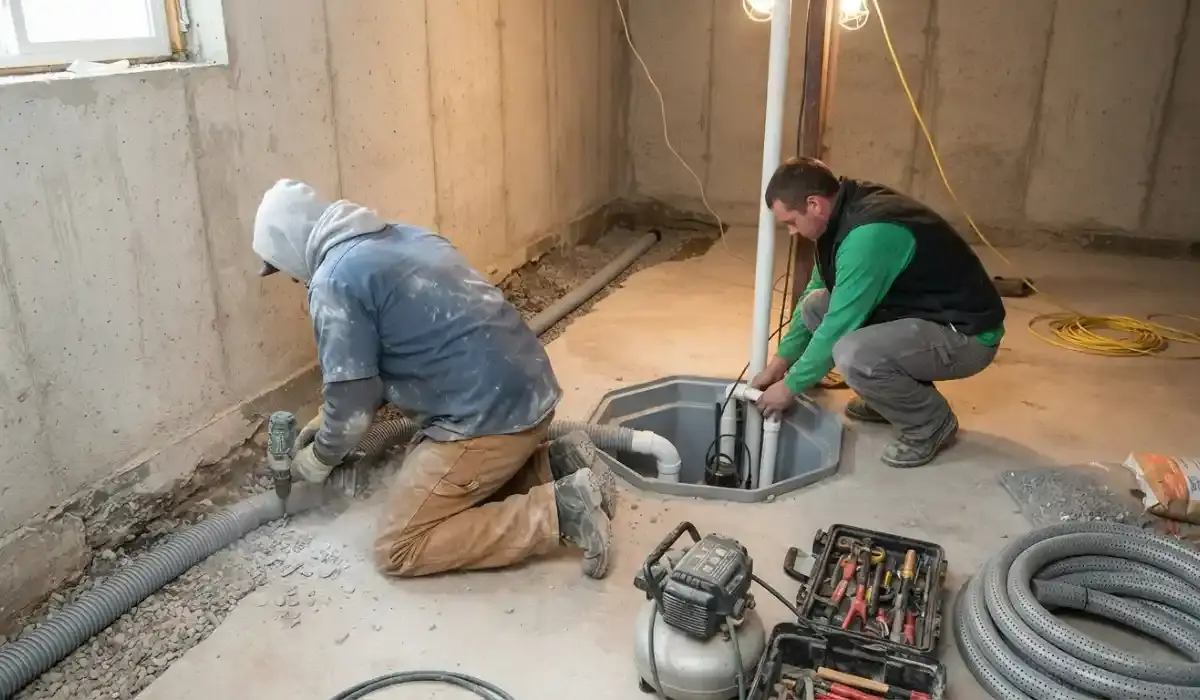
Plumbers install interior drains, sump pumps, discharge lines and backflow protection, and we diagnose plumbing leaks that mimic seepage. Foundation cracks that move, bowed walls and large excavation belong to foundation and excavation contractors. A good specialist will tell you which parts they handle and which they do not.
Start by ruling out the cheap causes. Extend downspouts, fix grading and clean window wells before paying for a system. Our page on sump pump repair covers the pump side.
Local conditions to bring up
Pleasant Grove sits at the foot of the Wasatch Range, and snowmelt and storms can raise groundwater near foundations. Some neighborhoods see seasonal seepage that others never do, and soils on the bench vary. Ask the contractor how they account for local groundwater, and ask the Pleasant Grove building department what permits apply to drains and discharge.
Source type: General Utah County groundwater practice and City of Pleasant Grove building department
How to compare quotes fairly
Ask for line items: drain length, pump model, discharge route, wall repair, permits and cleanup. Two quotes with different drain lengths are not comparable. Ask what is included in the warranty and who honors it if the company closes.
If you want a plumbing opinion on a leak you cannot trace, leak detection can rule out a supply line. For neighboring properties, see our pages for Lindon and Highland.
What to have in writing before work starts
A clear written agreement protects both sides, and good contractors expect to provide one.
- The full scope, with each system, length and product named.
- The total price, the payment schedule and what triggers each payment.
- The start date, the expected duration and any permit responsibilities.
- The warranty terms, including what is excluded and how to make a claim.
- The contractor's license number and proof of insurance.
How to judge whether the work is done right
After installation, watch for water over the next few storms and during spring melt. A good system moves water to the pit and out, and the floor stays dry. Test the sump pump yourself, and ask for a walk through of how the system works and what to maintain.
Keep every document. A warranty is only useful if you can prove what was installed and when. Photograph the work before walls and floors are finished, since you will not see it again.
Low-cost steps to try before a big project
Many wet basements improve with simple changes. Extend downspouts several feet from the foundation, build up soil so it slopes away from the walls and keep sprinklers from soaking the foundation. These steps cost little and can cut the water that reaches the basement.
If seepage continues after those fixes, you have better information to give contractors. You can tell them what you already did, and a fair quote will reflect it.
Reading reviews and references with care
Online reviews help, but read them for detail. A review that names the problem, the fix and how the basement held through a storm is more useful than a bare five stars. Look for how the company handled problems, since every contractor has some.
Ask for references from jobs at least a year old, and call them. A year shows whether the system survived a wet season. Ask whether the work stayed on budget, whether the crew cleaned up and whether the contractor returned when asked.
A simple rule for choosing
Pick the contractor who explained the cause of your water in plain words, offered a scope that matches it and put everything in writing. The cheapest quote is rarely the best, and the most expensive is not always the most thorough.
If two bids are close, choose the one whose references you could reach and whose license you could verify yourself. Trust is built on facts you can check, and that is the point of the exercise.
Hiring questions
Utah licenses contractors, not all certifications. A verified license and insurance matter more than a badge. Ask what the certification covers.
Interior drain systems often take a few days. Exterior work takes longer.
Some are, some are not. Ask in writing, since it matters if you sell.
Yes, two or three. Compare scope line by line, not just price.
We install drains and pumps and say when another trade is needed. Foundation repair and excavation are separate trades.
Use the state Division of Professional Licensing online lookup and search by name or license number.